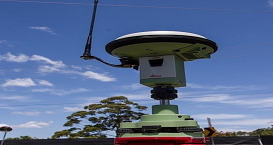
On the morning of February 26, 2026, at the invitation of Professor Geng Jianghui, Dr. Guo Jiang, a postdoctoral researcher from the International Bureau of Weights and Measures (BIPM), and Yang Songfeng, a doctoral candidate from the University of Melbourne, delivered outstanding academic presentations to faculty and students in Room 206 of Building 3 at the Institute of Precision Measurement.
The first session featured Dr. Guo Jiang presenting “Generation of Continuous GNSS Time Scales Based on Phase Clocks.” Dr. Guo highlighted that the existing IGS Time Scale (IGST) is significantly affected by pseudorange noise and has limitations in tracing Coordinated Universal Time (UTC).
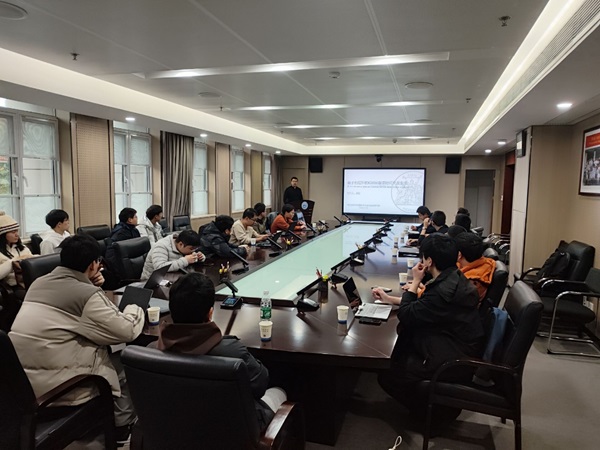
To address this issue, Dr. Guo proposed a novel method for generating a time scale using phase clock differences after integer ambiguity resolution. This approach was experimentally validated using products from the IGS Wuhan Combination Center (WCC). Results demonstrated that the newly generated phase time scale exhibits significantly improved short- and medium-term stability compared to IGST, with the epoch error root mean square (RMS) reduced from 12 ps to 7 ps—an approximately 42% improvement. Furthermore, his proposed strategy of directly aligning UTC(k) stations achieved time scale and UTC deviation control within ±1 ns, substantially outperforming traditional IGST. This research pioneers a new pathway for integrating global time measurement systems with geodetic products.
Subsequently, Dr. Yang Songfeng delivered an academic presentation titled “Feasibility Study of Short-Baseline Positioning Based on LEO Frequency-Modulated Carrier Phase.” Addressing application bottlenecks of Global Navigation Satellite Systems (GNSS) in visibility-constrained environments like urban canyons, Yang explored the immense potential of commercial Low Earth Orbit (LEO) communication satellites as distance observations to enhance positioning capabilities.
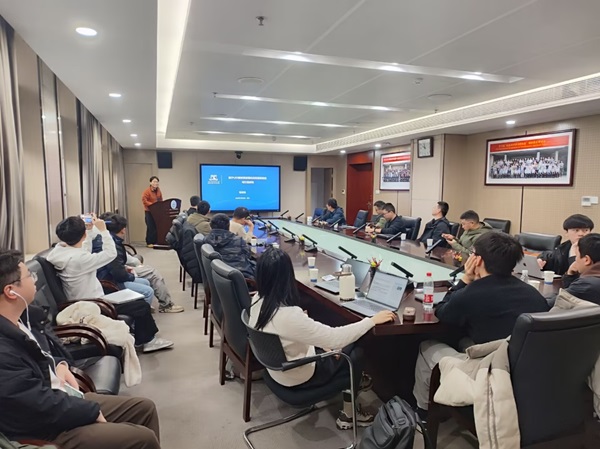
His research focused on evaluating short-baseline positioning performance using only LEO satellite frequency-modulated carrier phase signals after ambiguity resolution. He assessed positioning accuracy across multiple independent constellations—including Iridium and Starlink—and combined GNSS modes. The experimental results are encouraging: even under extreme conditions with satellite cut-off elevations as high as 50 degrees, near-real-time centimeter-level relative positioning is achievable on ultra-short baselines of approximately 5 kilometers. This achievement provides a practical theoretical basis and technical pathway for high-precision positioning in complex environments.
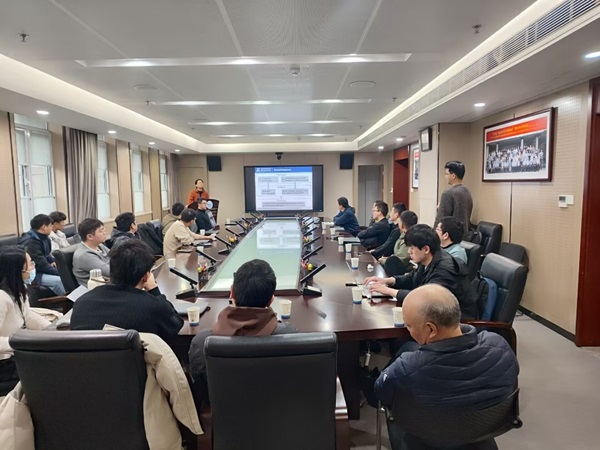
Both seminar sessions featured lively discussions, with faculty and students engaging in in-depth exchanges with the presenter on topics including LEO satellite signal processing and high-precision time transfer.
Copyright PRIDELAB IN GNSS CENTER , Wuhan University Visits:290384 Powered by Truesing