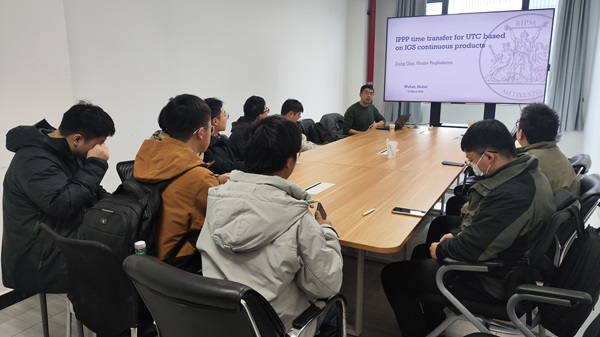
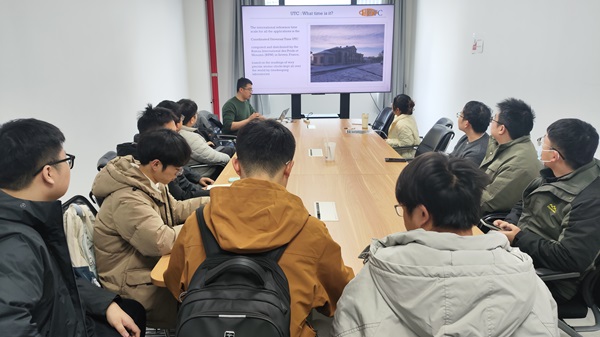
On the afternoon of March 2, 2026, at the invitation of Professor Geng Jianghui, Dr. Guo Jiang, a Postdoctoral Researcher from the International Bureau of Weights and Measures (BIPM), visited the GNSS Research Center at Wuhan University. Dr. Guo delivered an insightful academic lecture titled "Multi-GNSS Continuous IPPP Time Transfer for UTC Maintenance" to faculty and students in Room 1410 of the Xinghu Building, fostering a strong academic atmosphere.
During the presentation, Dr. Guo systematically elaborated on the development and technological evolution of Precise Point Positioning (PPP) technology in the field of international time and frequency comparison. He noted that since its inclusion in the BIPM's Circular T in 2009, PPP has become one of the key methods for global time and frequency comparison. In recent years, significant breakthroughs have been made in integer ambiguity resolution-enabled PPP (IPPP) technology, achieving frequency stability better than 10⁻¹⁷ over long averaging intervals (using GPS as an example), which substantially enhances high-precision time and frequency transfer performance.
Addressing the current challenges in the calibration accuracy of Coordinated Universal Time (UTC), Dr. Guo provided an in-depth analysis of how errors in PPP time links constrain UTC accuracy. He emphasized that as high-stability Optical Frequency Standards (OFS) begin contributing to UTC calculations, the accuracy limitations of traditional PPP methods become increasingly pronounced. Consequently, the development of multi-constellation IPPP technology is of critical importance for maintaining and enhancing the operational capability of global time scales.
The lecture highlighted a multi-day IPPP time transfer methodology based on the rapid products (WUMRAP) from the IGS Wuhan Analysis Center. Leveraging the PRIDE PPP-AR and Atomium software platforms, the research team developed a multi-day IPPP processing strategy that effectively mitigates link discontinuity issues in high-precision clock comparison. Systematic evaluations of rapid products from the IGS Wuhan Analysis Center, CNES, and CODE demonstrated that multi-day IPPP can effectively maintain link stability, showing potential for integration into the BIPM Circular T services.
During the interactive session, faculty and students engaged in in-depth discussions with Dr. Guo on cutting-edge topics such as multi-constellation PPP data processing, ambiguity resolution strategies, and optical clock comparison. The lively exchange fostered a vibrant collision of academic ideas.
Copyright PRIDELAB IN GNSS CENTER , Wuhan University Visits:290384 Powered by Truesing